Share the joy of reading with your children during school closures
Posted by Remya Padmadas on March 18, 2020Whether you are an educator looking for distance learning solutions, or a parent looking for ways of keeping your little ones engaged, or someone who cares about children having uninterrupted access to reading resources even during school closures due to the COVID-19 outbreak - StoryWeaver is here to support you.
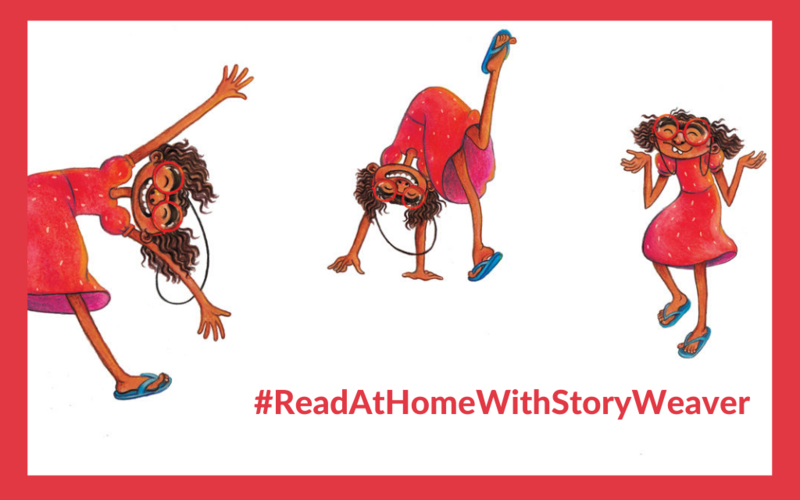
Illustration by Ekta Bharti, for I Love Me, written by Menaka Raman and published by Pratham Books.
We have more than 19,000 storybooks in 230 languages, available on our platform www.storyweaver.org.in which you can read online, on your phone, download or print PDFs, all for free. Here are some of the other ways that you can use StoryWeaver:
--> The Reading Programme is an easy-to-use, curated collection of books, themes and activities, tailored to suit the learning needs of children from Grades 1 to 8. Sign up for free and help children fall in love with books and reading! http://bit.ly/33jYdMl
--> The STEM Reading Lists have a collection of storybooks that spark curiosity and interest in children to explore concepts related to science, math and technology: http://bit.ly/3aR5RR9
--> The Readalongs are audio-visual storybooks that early readers can listen to as they learn to read. These books have subtitles that mirror the audio narration of the story, which help children build language acquisition skills: http://bit.ly/3aS5Nk2
--> StoryWeaver’s English and Hindi YouTube channels have delightful, artfully narrated video stories to engage children and nurture their thinking and imagination.
Explore StoryWeaver’s local language digital libraries that are available in Amharic, Assamese, Bahasa Indonesia, Bangla (Bangladesh), BasaJawa , Bengali, Chinyanja, Farsi, French, Gondi, Gujarati, Hindi, Igbo, Kannada, Khmer, Kiswahili, Kolami, Konkani, Korku, Luganda, Macedonian, Marathi, Nepali, Odia, Punjabi, Serbian, Tamil, Telugu, Tibetan, Urdu, Vietnamese and Yoruba, to name a few.
If you are looking for more distance learning solutions, here is a comprehensive list shared by UNESCO.
Thanks to the power of open licensing, technology, and our network of wonderful authors, illustrators, translators and partners, we can give children around the world free access to joyful reading material, even during school closures.
Keep calm, stay safe and #ReadAtHomeWithStoryWeaver.
P.S. Do share your ‘read at home’ moments with us on Facebook, Instagram and Twitter using #ReadAtHomeWithStoryWeaver, and inspire our community!
Be the first to comment.StoryWeaver Spotlight: VARSHA GAJENDRAGADKAR
Posted by Remya Padmadas on September 29, 2018Vasrha Gajendragadkar is a creative writer and translator. She has authored and translated more than 25 books including children's books, creative prose, fiction and non- fiction works and environment related writing. She is also the recipient of two state literary awards.

Q: Can you tell us anything about yourself and your job that would surprise us:)?
A: Basically I am a creative writer and a translator. The number of books authored and translated by me is 25+. As a professional, I am in the field of content creation and development for last 25 years. Besides literary writing and translation I have dealt with variety of assignments like script writing for educational documentaries, storyboard writing for E learning courses, copy writing for advertisements, case study report writing, technical and scientific translations and many more.
I am glad to mention that my story book for children has received the state literary award in the children’s literature section in 2013 and my translated fiction has received the state literary award for best translation in 2014.
Q: What is your personal relationship to language and/or translation?
A: I am blessed with a strong and rich legacy of literature. My father (Dr. R. C. Dhere) was an erudite literatieur and scholar in the field of ancient literature, culture and folklore. I am born and brought up in a house where books are regarded as a major asset. Naturally I have a closer bond with language and literature. It is not just a medium of expression for me; but language is my identity. So in spite of having a post -graduate degree in science stream, I chose to focus on writing.
As regards translation, I have an intense passion for it. At the age of 22 I dared to start translating a classic and the best seller Gone with The Wind. It was my first ever translated work (It took 11 more years to see the light. It was published in 2009.) I have been in both literary and professional translations for last two decades and madly love translating fiction, especially children stories. My science background is an added advantage for me, since I am able to translate STEM content with more ease.
Q: When you’ve been given a story to translate, what’s your process, and how long does it generally take?
A: I read the entire story, first as a reader, to enjoy it. Second time when I read the same, I start retelling it to myself. It helps me to avoid the literal, word to word translation. Then I begin with actual translation. Even after completing the entire story, I read and re read it loudly to bring it maximum close to the original work, still giving the flavor of Marathi language and culture.
It is really difficult to tell the time required for a translation. It can happen so that a seemingly simple and short story is too difficult to translate. In such cases it requires more than 3-4 drafts to make it final and satisfactory.
Q: What do stories in translation bring to young readers?
Similar to original works, translated stories are treasures of entertainment for children. But more than that translations abate the young readers to know different regions with different cultures. In short they introduce children to the broader world and connect them with the distant people. These bonds help for their intellectual and emotional development. Moreover, translations increase the vocabulary and linguistic skills of children, since many a times new word are either coined or used creatively by the translator to bring the exact sense of the original content.
Q: How did you cultivate the skills needed to translate books for children?
Right from my school age, I happened to read variety of translated books. I read translations of Rabindranath Tagore, Sharadchandra Chattopadhyay, Premchand, Tolstoy, Maxim Gorky, Arthur Conan Doyle and many more. When I began with the translations it was at the back of the mind that the young readers must enjoy the translations like I did. The translated work should be as enriched and interesting as the original work so that children will be able to relate themselves with it. I consciously make it a habit to retell a story to myself, assuming that I am a child. This makes me think and select the appropriate words and phrases that would be close to the children’s world. I am always agile that my translations should help them cross socio-cultural boundaries without feeling they are doing so. I am of the opinion that translation is not entirely related to developing skills. It is related to your ability to unite with soul of the original author and what it requires is sensitivity, more than the skills.
Q: You’ve translated many stories for us. Which has been your favourite to work on?
A: I have translated more than 30 stories for Pratham Books. It is really a wonderful bouquet of variety of stories originated by writers across India. Actually it is difficult to name any one but I have enjoyed translating ‘’What Happened to the Old Shawl?” and 'Neelumbera on a Full Moon Night”.

Q: What is the hardest thing about translating from English into Marathi? How do you navigate words or phrases that are tricky to translate?
A: There are two major challenges in translating English fiction. Socio-cultural disparities and different literary expressions create hurdles in translation process. Secondly, it is as difficult as a rope walk. On one hand you have to stick to the original work (means you have limited freedom) and on the other hand you should be careful not to create a corrupt copy.
When there are no parallel words or phrases in Marathi, I squeeze out the essence of the content and re formulate the same so as to bring an original flavor. The words I use may not be of the same meaning but they underline the same emotions.
Q: How do you feel when your story reaches the child?
A: It is an ultimate delight when your creation is the hands of those for whom it is targeted. I do feel that translation is a creation just like the original work. In fact, it is more difficult and complex a creation since you have limited freedom.
Q: How else do you think we can join hands to take more stories to more children in more languages.
A: As far as I know, currently we are translating the stories mostly from English or Hindi. We can also do the other way. Stories from regional languages can also be translated into English and Hindi and then taking them into other regional languages. As for expanding the reach, we can always join hands with the schools and NGOs working for children.
Q: Can you tell us a bit about the xx translation community?
A: Marathi has a long tradition of translated works. Many known authors have translated very good books from both regional and foreign languages. For last couple of decades many versatile translators have come up in Marathi and they have effectively translated both fiction and non -fiction work from variety of languages. The number of youngsters interested in translations is also on rise. Translation as a profession is also blooming with speed for last few years.
Q:What type of person do you think makes the best translator for children’s stories?
A: In my opinion, a sensitive and creative person having literary skills will be able to translate children’s stories.
Q: Do you have any advice for anyone interested in becoming a translator?
A: I would like to suggest them that keep reading, keep writing and keep rehearsing until you are able to bring the intensity of the original work in the translation. Let translation become your passion, before it becomes your profession.
Q: A book you'd like to recommend to other translators?
A: Stories by Hans Chistian Anderson. He is a Danish author. And his enigmatic fairy tales are translated into English by H. P.Paull and some other writers. Some of his stories have also been translated earlier into Marathi. But there is surely much scope to retranslate those and take up some more. They are really mesmerizing.
Be the first to comment.StoryWeaver's partnership with Jala
Posted by Remya Padmadas on October 21, 2019Jala is a translation platform that combines human skill with translation technology to make high quality translations accessible to those who need it the most. It collaborates with organisations, communities and individuals to help bridge the language barriers and increase access.
Earlier this year, Jala teamed up with StoryWeaver to help build a high quality repository of openly licensed storybooks in Chinese and Bahasa Indonesia. To get some insight into the translation process, they interviewed Sophia, a Jala user and hobbyist/ freelance translator, who translated five stories on StoryWeaver from English into Bahasa Indonesia. You can read an excerpt from the interview below.

Sophia, who translated storybooks from English to Bahasa Indonesia.
Hi Sophia! Thanks for being such an active user on Jala! Can you tell us a little about why you decided to translate the StoryWeaver books?
Hello! It was my pleasure. Well, firstly a little background about me. Bahasa Indonesia is my native language, but I moved to Singapore at the age of 15, and then later moved to the UK. So English has been the language I have spoken more actively. But ever since I started working in the publishing industry and have focussed on developing Singaporean content for Singapore, I began to miss home, and I began thinking about reconnecting with Indonesia. I feel a little like an outsider to Indonesia now, and I was not sure how I could help local readers in Indonesia. So when the opportunity to translate children’s books on Jala into Bahasa Indonesia came along, I was quite excited by the idea! It felt quite perfect. While my Indonesian language abilities have withered a little, mainly due to lack of practice, I felt that working on translation really helped to revive my language skills! Translating children’s stories had its own challenges for me. For example, word choice, which had to be suitable. I had to be sensitive about how an Indonesian child would understand the words I had chosen. It made for an interesting puzzle for me!
That’s great. What did you like most about the stories that you translated?
Like any children’s book, there was a nice rhythm to the stories. There were moments when I felt that the words in English had a rhythm, which I tried to capture in my translation. Knowing the natural rhythm of the book, I tried to ensure my translation stayed true to the original in terms of sentence length and word choice.
I liked that the stories were upbeat and (mostly) positive. For example, in Fati and the Honey Tree, even though the girl (Fati) fell down and hurt herself, there was still a positive message at the end. I also enjoyed the unique settings for the stories, everything from the environment to the characters and how they interacted with their surroundings.

Fati and The Honey Tree
The Indian and Ghanian cultures were very refreshing to me, and something I feel that is lacking in publishing, as most settings are very Western-centric. Finally, I liked how each story teaches something. For Let’s Play, it was science, through the introduction of simple concepts in a child’s everyday world.
This is really great to hear! What was the translation process like for you?
I was very methodical in my translation process, after the first one, I actually figured out what worked best for me and then came up with my own methodology which I actually have written down on my phone!
To start off I usually skim the original text first. I then proceed to do the translation line by line on Jala. I go through it once and have a first draft ready. I then go through both the original and the translation, by carefully comparing the two, and making any corrections along the way. I then read through just the translation to see how it flows and if I’m comfortable with it on its own. When I’m happy with what I have, I leave it for a day and then come back and read the translation again and do a final comparison with the original before submitting the piece. I like how Jala will always save my work, and I know that my progress will be safe until the next time I revisit the project!

Stories on the Jala platform
Of all the translations that you worked on, which was your favourite story to translate, and why?
I liked Fati and the Soup Pot the best.

Fati and The Soup Pot
Fati’s attitude was really funny in the story. I also liked how despite the fact that Fati’s mother knew that Fati had done wrong, she did not punish or scold Fati in the way you would expect parents to. In addition, I felt that the description of the cooking process and the listing of ingredients was a nice touch! If you are curious enough, you could attempt to recreate the dish! It also really liked that the child was involved in the cooking process!
What do you enjoy about freelance translation?
I think what I find most appealing is the extra income. But I also do believe there is a more interesting aspect to freelance translation. For instance, gaps in languages can be filled by multilingual individuals or translators. Being able to help and contribute to a specific skill is really interesting! I also think it’s a really great cycle, the more you do, the more interested you are, and the more that you learn! For example, when there are natural disasters, you see NGOs making open (and urgent) calls for translators for a specific language. Often, contributions can be through knowledge instead of money or goods, which is so meaningful when you are filling a gap. Even in non-dire circumstances, I believe that translators can make a difference.
To read the original interview, click here.
You can read the stories translated by the Jala Community on StoryWeaver here.
Please join the conversation by leaving your thoughts in the comments section below. You can also reach out to us through our social media channels: Facebook, Twitter and Instagram.
Be the first to comment.