StoryWeaver Community Spotlight: Professor Lea Shaver explains Book Hunger and the steps we can take to mitigate this crisis
Posted by Pallavi Kamath on September 01, 2020This is the 1st post in a two-part series featuring the work of Prof. Lea Shaver, the world's leading expert on book hunger and the right to read. She is tenured at Indiana University's Robert H. McKinney School of Law, where she teaches copyright law and human rights law. Her research on intellectual property and distributive justice has shaped international law at the United Nations. She is a long-time advocate of StoryWeaver and its open-licensing philosophy.
Purvi Shah, Director - StoryWeaver says: “We were introduced to Lea’s work way back in 2014, through a research paper she had authored. The paper's focus was on copyright, how it promotes social inequality and can be a barrier to access. We reached out to her and walked her through Pratham Books’ open license philosophy, and how it helps address issues of access and gives agency to stakeholders to create content they need and can use. This led to our story being extensively referenced in her latest book Ending Book Hunger. A big thank you to Lea for raising awareness about and sharing solutions to these challenges of access and literacy.”
Read this piece by Professor Shaver, to understand the pressing issue of ‘book hunger’ and the steps we can take to mitigate this crisis.
Worldwide, one billion children have virtually no reading material. Over the long term, book hunger is almost as dangerous as the regular kind.
Early and consistent access to reading material is essential to literacy skills. And fluent literacy is key to academic success and escape from poverty.
An extensive body of research demonstrates that a book-rich environment is critical to a child’s educational achievement and future income. The “book effect” has been demonstrated in countries both rich and poor, communist and capitalist, and across diverse cultures. Sociologists Mariah Evans, Jonathan Kelley, and Joanna Sikora reviewed studies on the relationship between books and life outcomes from forty-two countries. They found that even the smallest of home book collections benefit children, and these benefits increase with the size of the collection. Growing up in a home with at least two hundred books promotes a child’s future success more powerfully than having parents with college degrees. This rigorous body of research proves what those of us who grew up with books already know.
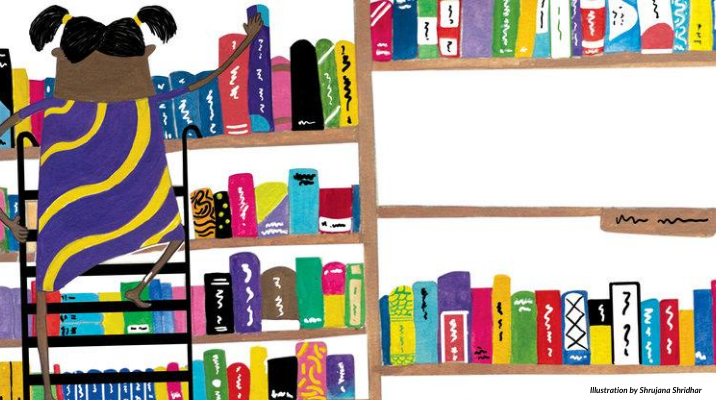
Children who read regularly for pleasure become fluent readers, take joy in learning, and perform well in school.
Books at home matter so much, because that's where children are most of the time.
Teachers all over the world are scrambling to figure out how to continue to support literacy while schools are closed. The most important step is to get books to every child. Simply providing books makes a big difference.
The viral pandemic has created a book crisis. And that should concern us greatly, because access to books is the number one determinant of educational achievement and future income.
So, how do we get books to students... fast... in both digital and paper formats?
There are several solutions:
- DIGITAL: Smartphones connect 4.7 billion people to the Internet. Virtual libraries can put a bookshelf in every pocket.
- LICENSING: Speeding up permissions helped libraries and schools better serve readers with blindness and other print disabilities.
- FAIR USE: Libraries and book charities can invoke existing legal flexibility to translate children's books into underserved languages.
- LEGAL REFORM: Lawmakers can legalize translations into disadvantaged languages, without impacting publishing income.
- OPEN BOOKS: Creative Commons licenses helped one nonprofit (Pratham Books’ StoryWeaver) go from producing a few dozen new books each year, to producing thousands.
- VOLUNTEERS: One in ten Icelanders will publish a book. It's not because they hope to get rich.
- SCALING UP: We can end childhood book hunger by 2030, but only through a strategy of mass translation, free eBooks, and cheap copies.
Book hunger is a solvable problem. If this issue matters to you, I'm excited to present 'Ending Book Hunger'. Discover innovative non-profit strategies to bring books within reach of every child, and what you can do to help. Visit: ‘Ending Book Hunger’ to learn more.
Illustration by Shrujana Shridhar, for बेटियाँ भी चाहें आज़ादी written by Kamla Bhasin, published by Pratham Books
StoryWeaver Spotlight: Nivedha
Posted by Remya Padmadas on July 01, 2019Nivedha is a Physics graduate currently working in the field of education. She enjoys taking science to kids through stories. She has translated many stories to Tamil for Pratham Books including 'Talking in Twos' and 'This is How You Count Eggs'. You can read her stories The Girl Who Thinks in Numbers: Data Warrior Prukalpa Sankar and The Scavenger Hunt on StoryWeaver. 
Q: Can you tell us anything about yourself and your job that would surprise us :) ?
I am a mildly mischievous person with good observation skills. No wonder I chose to study science and became a physics graduate eventually. Now I work in an education-based organisation where I develop content for school kids. While designing language lessons, I try to include storytelling elements to it. It’s quite interesting!
Q: What is your personal relationship to language and/or translation?
Being a single child to my parents, books have been the biggest companion to me since childhood. I remember reading books even when I couldn’t understand the meaning of most parts of the text. Language feels like a cosy and comfortable space that my mind loves going to!
Q: When you’ve been given a story to translate, what’s your process, and how long does it generally take?
First, I read the story three to four times. During the initial reads, I consciously ignore the fact that I am reading it for the purpose of translation. It helps to grasp how a particular story might feel/appeal to a reader.
In the next step, I read about the region/culture where the story happens. For STEM stories I make sure that I revise/read the science concepts that are dealt with. This process I stretch across a few days to a week and when I sit to write it down it doesn’t take more than a few hours.
Q: In your opinion, what do stories in translation bring to young readers?
Children love exploring new things. These stories provide an exposure to other cultures and people. I believe it helps the kids to know about the differences existing among us or feel that it is okay to be different.
Q: How did you cultivate the skills needed to translate books for children?
Translation is relatively a new thing to me and I have a lot to learn. I read children stories and translated stories. Reading translation related discussions on digital platforms also help me. I also watch child centred cartoons like ‘Peppa Pig’ where an episode is like a visual short story of 5 minutes and then imagine how we can give similar experience through the text .
Q: What was the experience of translating a children’s book like, compared to translating for adults?
The exposure and worldview that a child has is very different from what an adult would have. So this has to be kept in mind too. Also, while translating for adults I feel there is a liberty to use slang, but for children had to go back to the basic words. During this process, I also learnt(had to learn) new words whose usage is not very common in spoken language.
Q: You are also a Physics graduate who loves the subject. How is the experience of translating STEM based stories? Are there any particular experiences/opinions from this experience?
I believe children grasp things quickly when it’s told as a story spun around their world and experiences. In that way, translating STEM based stories make me happy as it helps in taking science to kids in an interesting way.
Especially, while translating the story “The Scavenger Hunt”, I was delighted at how the basic concept of filtration was taken and woven into the story. When Lajjo (the main character) goes in search of tools, we could see that how a tool/object is accessed/placed varies for each culture. It gave me an insight that our interaction with the material world is not the same and thus teaching science in the same way to everyone may not work in all cases.

Q: What is the hardest thing about translating from English to Tamil? How do you navigate words or phrases that are tricky to translate?
I find translating the technical words/jargons to Tamil the hardest. Most times people would be familiar with the actual English terms than Tamil. In that case I refer to dictionaries, other tests and try to use an easier, relatable Tamil equivalent. I also cross check with my friends if they can understand that word/phrase.
Q: How else do you think we can join hands to take more stories to more children in more languages?
Book fairs are a great way to reach Children. The publications concentrating on children and young adult literature can collaborate and come up with a dedicated stall for them. (This from my experience in Chennai book fair. Though many kids come, availability of books in regional languages is not sufficient.)
This platform can also be used to attract talent who are interested in children’s literature.
Q: What type of person do you think makes the best translator for children stories?
Anyone who has a love for language and is open to learn from everyone and everything can make a good translator.
Q: Do you have any advice for anyone interested in becoming a translator?
I think I still am in a place to receive a lot of it? 😊 Anyways, I would say to be open to learning and observe the language of people around you. It helps a lot.
Q. A book you would recommend to other translators?
Eriyum panikkaadu (எரியும் பனிக்காடு) by R. Murugavel (Originally written in English by P.H.Daniel). I didn’t even have the slightest thought that ‘Eriyum panikkaadu’ could be a translated book when I first read it. Such was the flow of text in the translation. Isn’t that an aim of every translator!
Be the first to comment.Who is Ameena? Enter our new illustration contest now!
Posted by Remya Padmadas on August 09, 2017IMPORTANT UPDATE: CONTEST DEADLINE EXTENDED TO AUGUST 30, 2017
Here’s your chance to illustrate a book for Pratham Books' StoryWeaver and get paid for it!
Some of us look at the word “tree” and doodle this:

And others conjure up something like this:
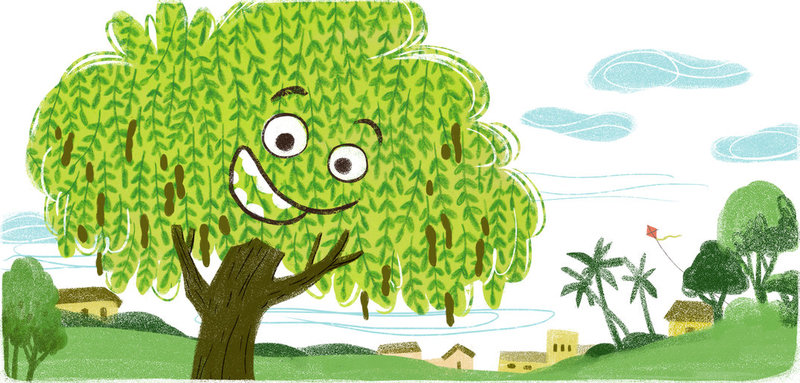
(Illustration by Archana Sreenivasan from 'Let's Go Seed Collecting')
or this:
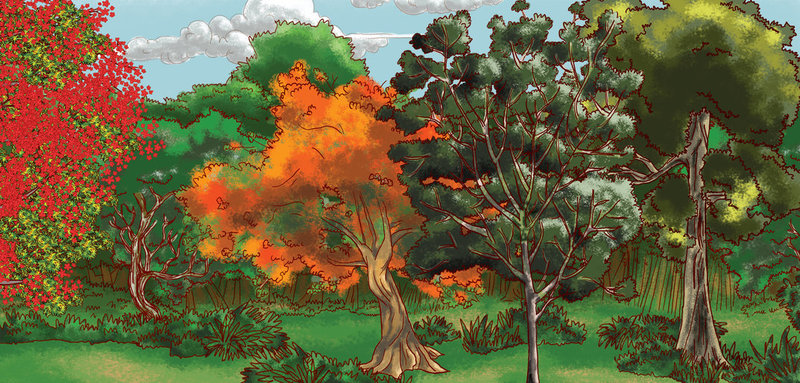
(Illustration by Vinayak Varma from 'Jadav and the Tree Place')
If you belong to the second category, then this contest is right up your alley!
Who is Ameena?
We have got a fabulous story coming up - 'What is Ameena Upto?', written by Roopa Banerjee. It is a charming story about a girl called Ameena and the antics she gets up to when her family isn't looking. We know Ameena is a mischievous little girl with a big imagination. But what does she look like? What does her family and her home look like? All of that is up to you! This is your chance to illustrate a children’s book for Pratham Books StoryWeaver!
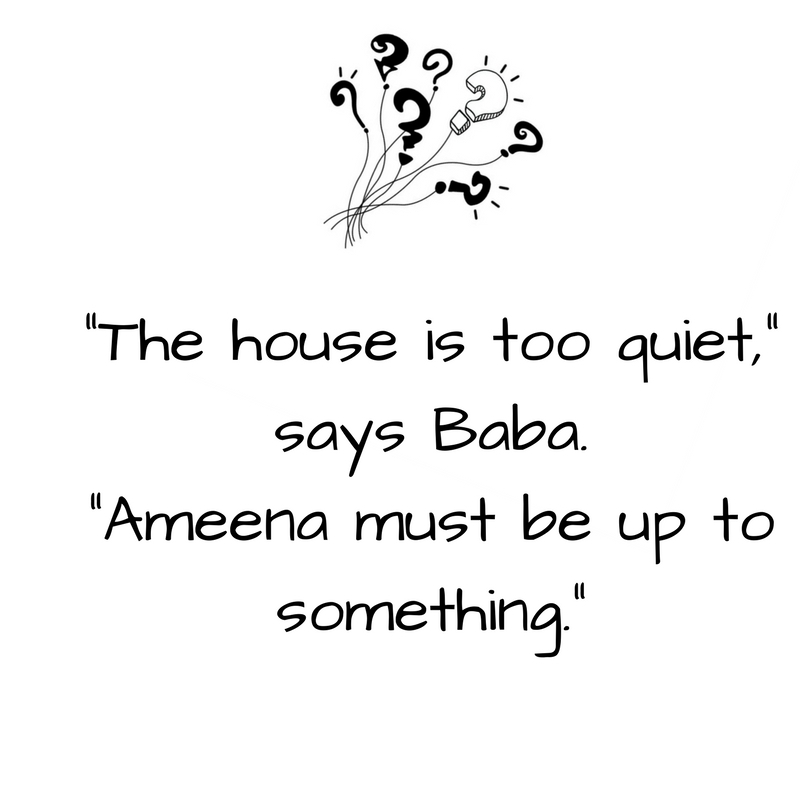
Here is an extract from the story ‘What is Ameena Upto?’
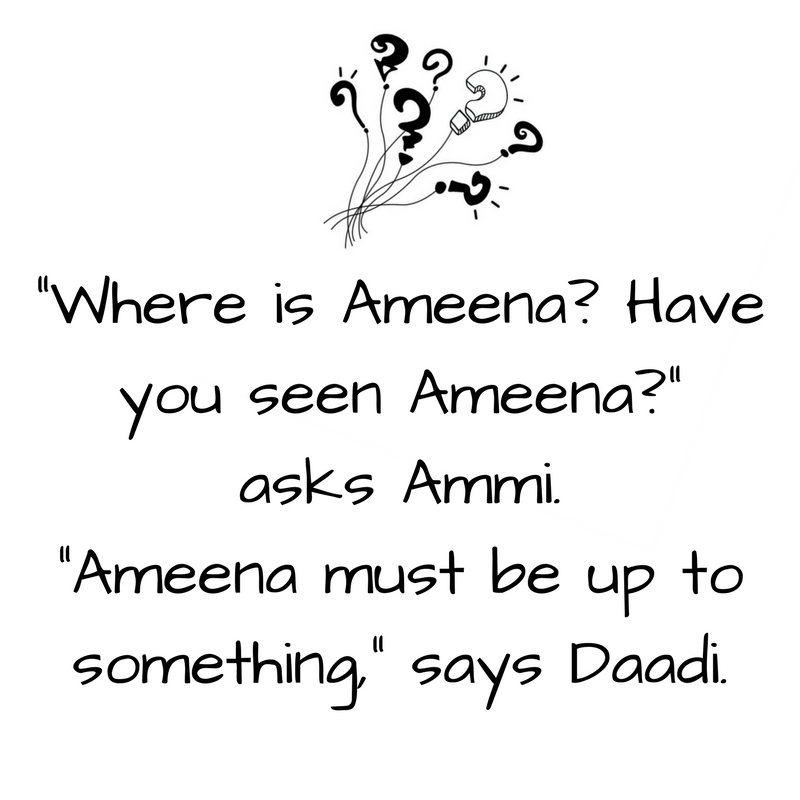
Everyone’s wondering what Ameena is up to on a sleepy Sunday afternoon. After all, where did the coconut shell, the paint, the buttons, and newspaper go?
The contest will be judged by award-winning illustrator, art director, writer, editor and overall publishing rockstar, Vinayak Varma. If we like your Ameena and vision the most, you will be chosen to sign a contract with us. You will get two months to illustrate the whole book, which will be published by Pratham Books on StoryWeaver. And yes, it’s a paid contract.
This is a Level 1 story, which is for children who are eager to begin reading. This is how pages of level 1 books look:
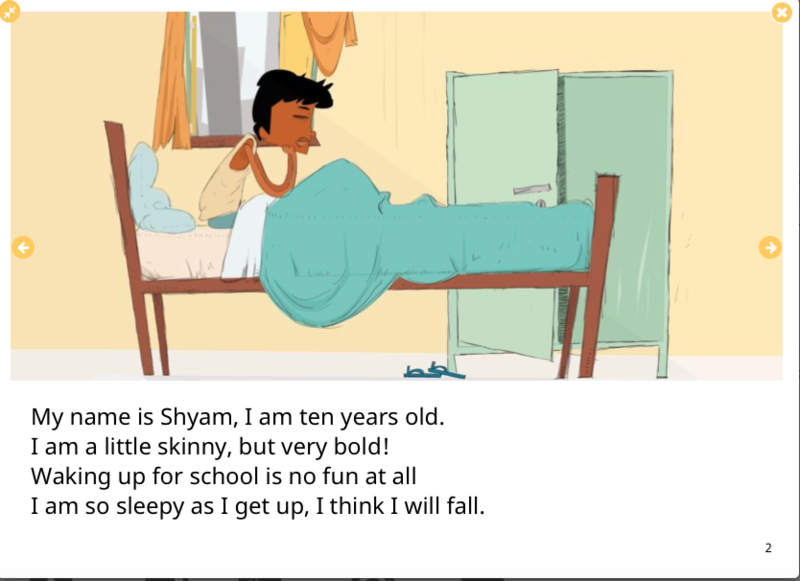
(From 'What If?', written and illustrated by Hari Kumar Nair)
Contest Guidelines
-
The contest will run from August 9-30, 2017.
-
Please send your illustration notes to [email protected].
-
Participants must be over the age of 17 to participate.
-
By submitting your original art work to 'Who is Ameena?' you are agreeing to a CC-BY license being applied to it (This license lets others distribute, remix, tweak, and build upon your work, even commercially, as long as they credit you for the original creation). To know more about CC-BY, click here.
Format
-
Size of illustration: 11.17 inches (width) x 5.35 inches (height). This is the recommended size as it fits neatly into one of the templates on StoryWeaver.
-
The illustrations should be high-res (150-300 dpi).
-
Format: JPEG
-
File size for each illustration: Between 2 to 4 MB; above 4 MB will slow down the upload process

For any queries, write to us at [email protected]!
comments (6)